Every year, governments, charities, and individuals invest resources in fighting poverty. They fund schools, support healthcare, improve infrastructure, provide emergency assistance, and help families develop sustainable livelihoods.
Yet poverty persists.
Some families escape poverty only to fall back into it. Economic crises reverse years of progress. Entire communities remain disadvantaged across generations.
It is therefore reasonable to ask: If poverty keeps coming back, does fighting it really make a difference?
The question is particularly important for people considering whether to donate to charitable organizations or support anti-poverty initiatives. If poverty is inevitable, perhaps these efforts merely postpone a problem that can never be solved.
But four decades of economic data and academic research tell a different story.
Poverty is persistent, and progress is often fragile. Yet the historical evidence demonstrates that poverty can decline dramatically, and research shows that well-designed interventions can create benefits that last beyond the initial period of assistance.
To understand why, we need to examine not only how many people live in poverty, but also where poverty persists, what causes people to fall back into it, and which interventions help make progress sustainable.
1. Has the world actually made progress against poverty?
The clearest evidence that poverty is not inevitable comes from the global historical record.
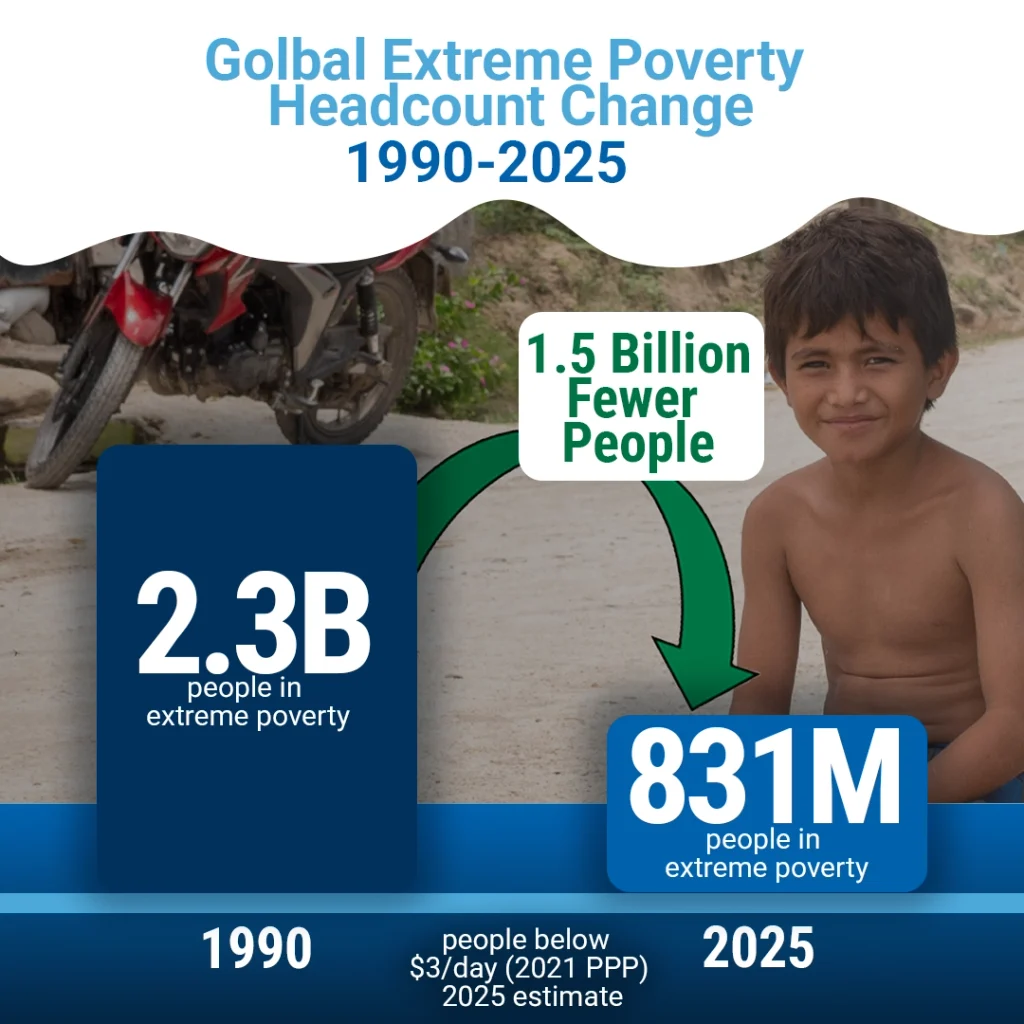
According to the World Bank, approximately 2.3 billion people lived in extreme poverty in 1990. By 2025, that number was estimated to have fallen to 831 million, using the international poverty line of $3 per person per day in 2021 purchasing power parity.
That represents a reduction of approximately 1.5 billion people, despite substantial growth in the world’s population.
Much of this transformation occurred in East and South Asia, where economic growth, expanding employment, increased productivity, and structural economic changes helped lift millions of people out of extreme deprivation.
This does not mean that economic growth alone explains every improvement. The benefits of growth depend on how opportunities are distributed, whether people can access essential services, and whether institutions support inclusive development.
Nor does it mean that extreme poverty has been eliminated.
Hundreds of millions of people continue to live below the international poverty line, and many more survive on incomes only slightly above it. The World Bank also reports that the pace of global poverty reduction has slowed considerably in recent years.
Nevertheless, the historical trend challenges the belief that poverty is a permanent, unchanging condition.
If extreme poverty were inevitable, it would be difficult to explain why its global prevalence has fallen so dramatically within a few generations.
The more useful question is not whether poverty can decline. The evidence shows that it can.
The question is why progress occurs in some places more rapidly than in others—and what makes those improvements last.
2. The poverty paradox: Why falling poverty rates do not always mean fewer poor people
One of the most important distinctions in poverty research is the difference between the poverty rate and the absolute number of people living in poverty.
The poverty rate measures the proportion of a population living below a defined poverty threshold.
The absolute poverty headcount measures the number of individuals below that threshold.
These indicators are connected, but they do not necessarily move in the same direction.
A country can experience a declining poverty rate while its total number of people living in poverty increases.
This happens when population growth is faster than the proportional reduction in poverty.
Latin America provides a real example
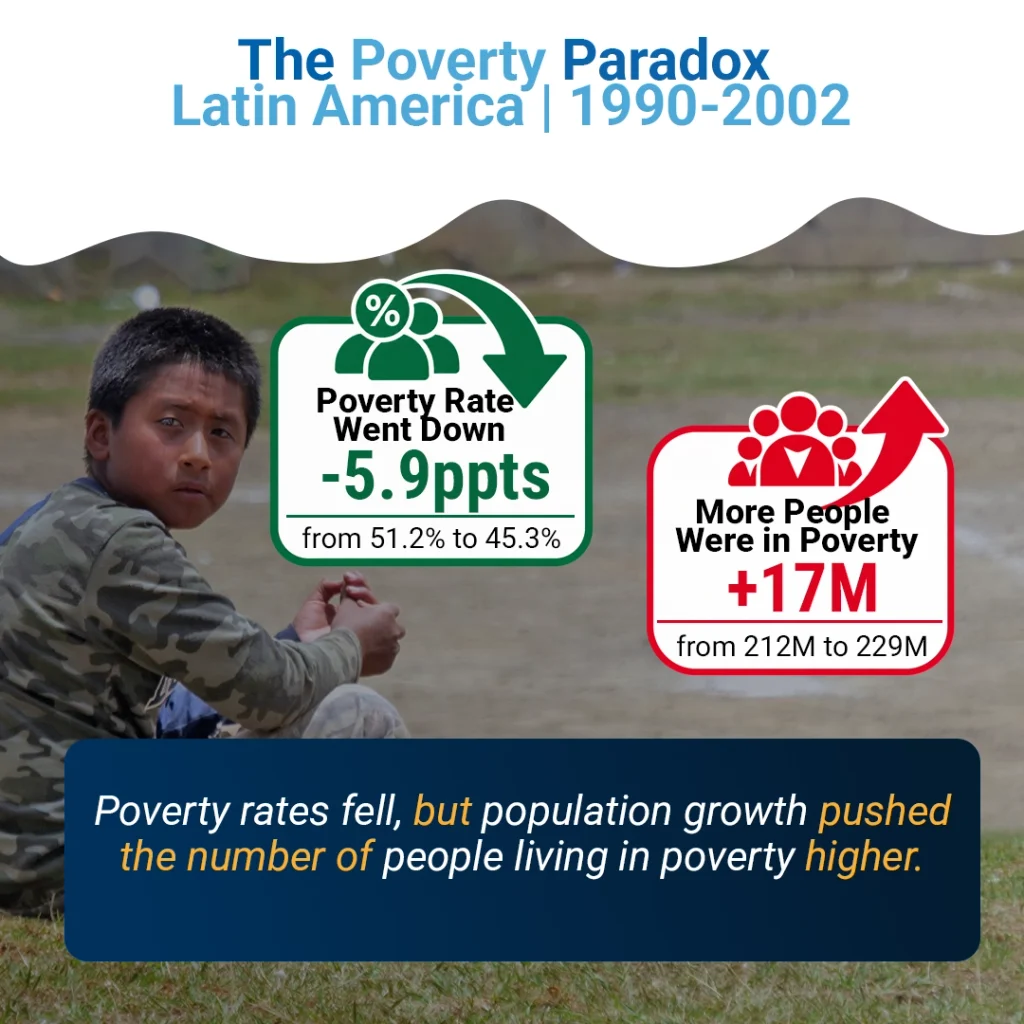
Between 1990 and 2002, Latin America’s poverty rate fell from 51.2% to 45.3%, according to the United Nations Economic Commission for Latin America and the Caribbean (ECLAC).
Yet during the same period, the absolute number of people living in poverty increased from approximately 212 million to 229 million.
At first glance, these numbers might appear contradictory.
How could poverty be declining if 17 million more people were living in poverty?
The explanation is population growth.
Although a smaller percentage of Latin Americans lived below the poverty line, the total population had increased enough to outweigh that improvement.
Does this mean the reduction in the poverty rate was meaningless?
Not at all.
A lower poverty rate means that fewer people were living in poverty than would have been the case if the earlier rate had persisted at the same population size. That arithmetic does not establish what caused the improvement, but it demonstrates why a growing headcount alone is an incomplete measure of progress.
And Latin America’s subsequent history provides an even more compelling example.
By 2014, the regional poverty rate had fallen to 27.7%, while the number of people living in poverty had declined to approximately 161 million.
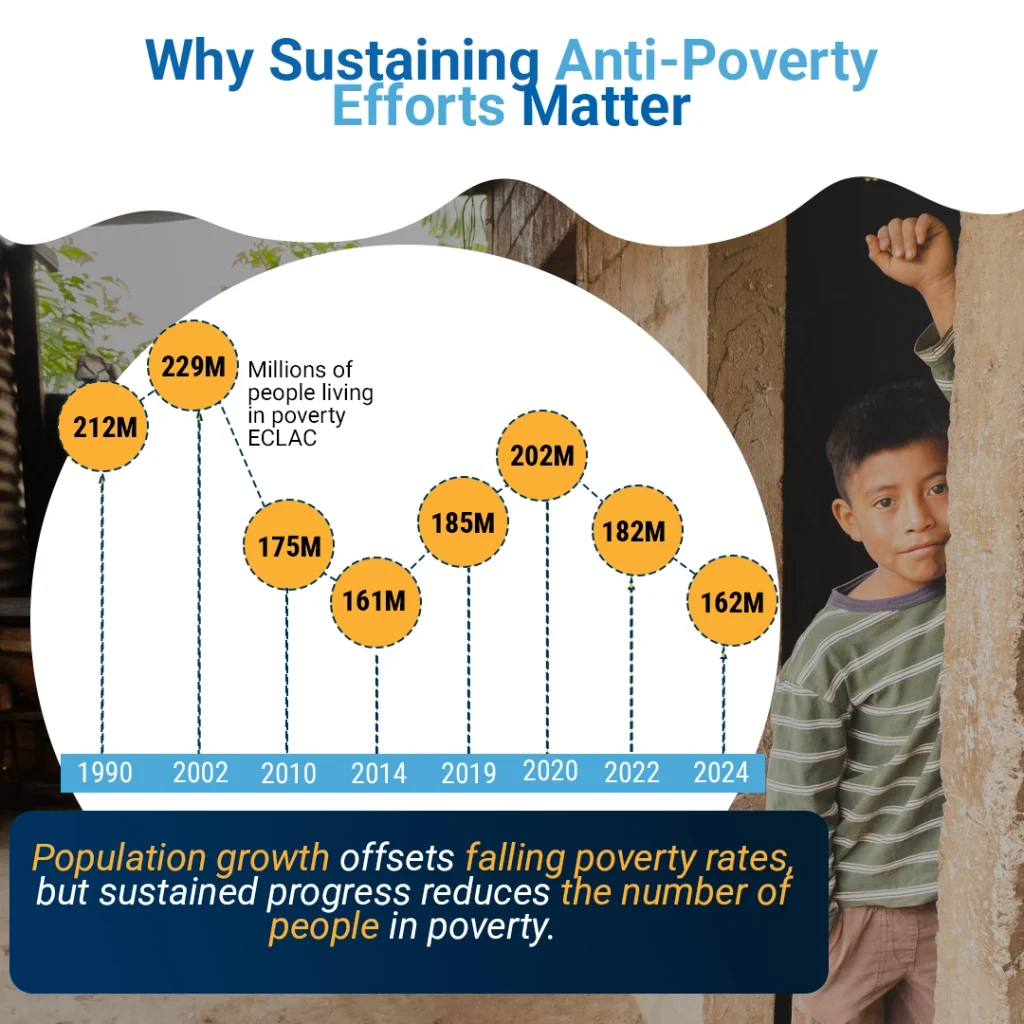
Source: ECLAC, Social Panorama of Latin America and the Caribbean 2025. Selected historical observations.
Between 2002 and 2014, the region went from 229 million to 161 million people living in poverty—a reduction of approximately 68 million.
This illustrates an important principle: population growth can initially offset improvements in poverty rates, but sustained poverty reduction can eventually lower the absolute number of people affected.
For anyone evaluating anti-poverty efforts, both indicators matter.
A falling poverty rate shows progress relative to population size. A falling poverty headcount shows that fewer people are experiencing poverty in absolute terms.
Neither measure alone tells us whether the same households are escaping poverty permanently. To understand that, we need research that follows households over time.
3. Latin America: Progress is real, but it can be reversed
Latin America’s long-term poverty reduction demonstrates what is possible. Its more recent history demonstrates why maintaining that progress is difficult.
During the 2000s, many countries in the region experienced improvements in household incomes, employment, and social protection.
However, economic stagnation and rising vulnerability contributed to a reversal in the following decade.
The COVID-19 pandemic exposed how fragile economic security could be.
In 2019, approximately 185 million Latin Americans lived in poverty. By 2020, that number had risen to approximately 202 million.
As economies recovered, poverty declined again. By 2024, ECLAC estimated that approximately 162 million people lived in poverty, representing 25.5% of the region’s population.
Latin America: Poverty rate and the pandemic reversal
Percentage of the population below ECLAC’s regional poverty threshold
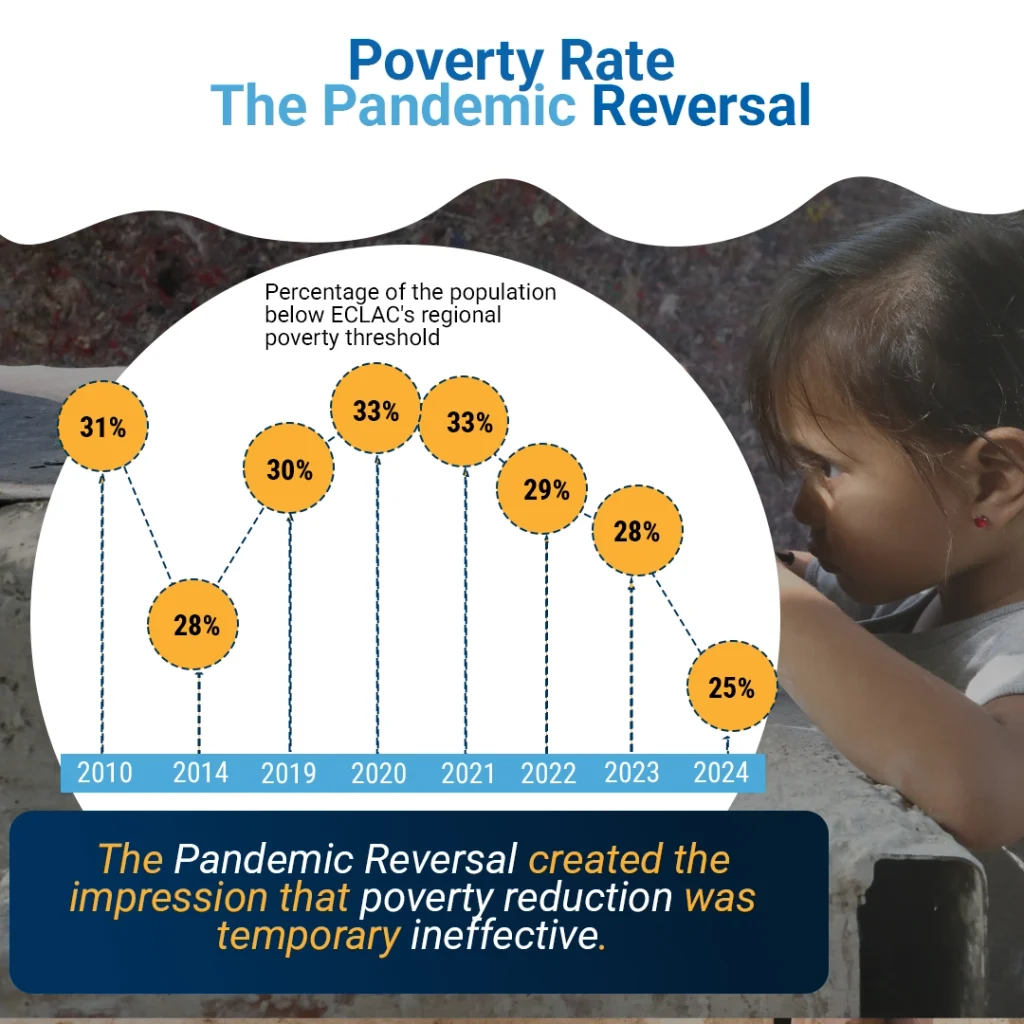
These reversals can create the impression that poverty reduction is temporary or ineffective.
But a reversal does not erase the benefits of earlier progress.
A family that experienced higher income, better nutrition, improved housing, or greater access to education over several years benefited during that period—even if a later crisis reduced its economic security.
At the same time, the risk of falling back into poverty highlights an important limitation of focusing exclusively on lifting households above a poverty threshold.
A household earning just enough to escape poverty may remain highly vulnerable to unemployment, illness, inflation, natural disasters, or economic downturns.
Reducing poverty and reducing vulnerability are related goals, but they are not identical.
Lasting progress requires helping people improve their circumstances while also strengthening their ability to withstand future shocks.
4. Why poverty persists: Rural isolation versus urban marginalization
Poverty is not experienced in the same way everywhere.
The challenges facing families in remote rural communities can be very different from those experienced by low-income households in large cities.
Peru provides a useful example of this contrast.
Rural Peru: When geography limits opportunity
In Peru’s Andean highlands and parts of the Amazon, geographic isolation can make escaping poverty particularly difficult.
For rural households, earning a sustainable income may depend on access to roads, markets, agricultural inputs, reliable infrastructure, education, and healthcare.
A farmer may produce crops successfully but struggle to transport them to market. A young person may complete primary school but face significant barriers to secondary education. Families may spend substantial time and money reaching essential services.
These disadvantages can reinforce one another.
Economists Martin Ravallion and Jyotsna Jalan explored the idea of geographic poverty traps: circumstances in which the characteristics of a location can limit households’ opportunities to improve their economic position.
Their research helps explain why poverty cannot always be understood solely through individual characteristics or effort.
Where people live can influence the opportunities available to them.
In Peru, research by Javier Escobal and other development economists has also highlighted the importance of rural market access, infrastructure, and territorial inequalities.
This suggests that effective rural poverty reduction may require more than transferring money to individual households.
Roads, schools, healthcare facilities, communications infrastructure, and access to markets can change the economic possibilities available to entire communities.
Urban Peru: When moving to the city does not guarantee security
For many rural households, migration to a city offers the possibility of higher earnings, better education, and improved access to services.
Peru’s capital, Lima, illustrates both the opportunities and challenges associated with urbanization.
Cities concentrate economic activity, employment, infrastructure, and public services. Moving to an urban area can therefore provide opportunities that are difficult to access in remote rural communities.
But urbanization does not automatically eliminate poverty.
Low-income households may face insecure employment, high housing costs, long commutes, inadequate infrastructure, and limited access to formal labor markets.
Many families rely on informal employment, which can expose them to unstable incomes and limited social protection.
Some households live in peripheral neighborhoods where reaching employment centers requires considerable time and expense.
In such circumstances, moving from a rural community to a city may change the form poverty takes without necessarily eliminating economic insecurity.
This does not mean migration is inherently unsuccessful. Many migrants experience meaningful improvements in income, education, and living standards.
Rather, it demonstrates that access to urban opportunities is not distributed equally.
Peru’s poverty reduction and reversal
Peru’s national monetary poverty rate fell from 58.7% in 2004 to 20.2% in 2019, according to the country’s National Institute of Statistics and Informatics (INEI).
This represented a substantial improvement in living standards.
Yet the pandemic reversed part of that progress. The national poverty rate increased to 30.1% in 2020 and remained at 27.6% in 2024.
The contrast between rural and urban poverty also remains important.
Rural poverty rates have generally been higher, reflecting persistent disadvantages in access to infrastructure, services, and economic opportunities.
However, because Peru’s population is predominantly urban, a large share of people living in poverty reside in cities.
The distinction matters for policy.
Rural interventions may need to prioritize connectivity, agricultural productivity, and access to essential services.
Urban interventions may need to address employment informality, affordable housing, transportation, and unequal access to economic opportunities.
A strategy that works in an isolated rural community may not address the most important barriers facing an urban household.
Poverty persists for different reasons in different places. Effective solutions must respond to those differences.
5. Do anti-poverty interventions actually have lasting effects?
The most important question for someone considering a donation is not simply whether poverty has declined historically.
It is whether deliberate efforts to fight poverty can make a meaningful and lasting difference.
Fortunately, this question has been studied rigorously.
In 2015, economists Abhijit Banerjee, Esther Duflo, and colleagues published a landmark study in Science examining a multifaceted approach to helping households living in extreme poverty.
The researchers evaluated programs in six countries, including Peru and Honduras.
Rather than relying on a single intervention, the programs combined several forms of support: productive assets, training, coaching, temporary consumption assistance, and encouragement to save.
The objective was to help extremely poor households establish more sustainable sources of income.
The results were encouraging.
Across the six-country study, improvements remained statistically significant in eight of ten outcome categories one year after the programs ended.
These included measures related to consumption, food security, productive assets, financial inclusion, and income-generating activities.
These findings challenge the assumption that assistance inevitably produces only temporary benefits.
They suggest that providing households with the resources and capabilities needed to generate income can create improvements that continue after direct support ends.
However, the results should not be overstated.
The study did not demonstrate that every participating household escaped poverty permanently. The magnitude of the effects differed across countries, and not every outcome improved significantly in every location.
The programs were also relatively intensive and involved multiple complementary components.
Nevertheless, the research provides evidence that well-designed anti-poverty interventions can create measurable benefits that outlast the initial assistance.
This is an important distinction from the claim that donations and development programs are inherently futile.
Different interventions serve different purposes
Not every intervention is designed to eliminate poverty permanently.
Emergency food assistance may prevent hunger. Medical support may prevent illness from becoming a long-term economic setback. Cash assistance may help families avoid selling productive assets during a crisis.
These outcomes matter even if the recipients remain below the poverty line.
Other interventions aim to create longer-term economic opportunities.
Education can expand future employment options. Infrastructure can connect communities to markets. Productive assets and training can help households generate income.
The effectiveness of an intervention should therefore be judged against its intended objectives.
A food program should not be dismissed because it does not create permanent employment. A livelihood program should not be considered successful merely because it provides temporary income.
The appropriate questions are: What problem was the intervention designed to address? Did it improve outcomes? How long did the benefits last? And was the improvement worth the resources invested?
6. Why the return of poverty does not make previous progress meaningless
One of the strongest arguments against anti-poverty action is also one of the most misleading: poverty can return.
But the possibility of future setbacks does not make previous improvements worthless.
We do not consider healthcare futile because people can become sick again.
We do not consider education useless because graduates may later experience unemployment.
Similarly, helping a household improve its living conditions can have meaningful value even if that household faces economic hardship again.
A period of greater financial security may allow parents to keep their children in school, obtain medical care, improve housing, or accumulate assets.
These benefits can matter beyond the period during which a household is officially classified as non-poor.
Of course, this does not mean repeated reversals should be accepted.
The challenge is to understand why poverty returns and develop policies that make households more resilient.
For some families, that may mean better access to stable employment. For others, it may require healthcare, savings, insurance, social protection, or improved infrastructure.
For communities facing structural disadvantages, it may require coordinated investment over many years.
The objective is not simply to help people cross a statistical threshold.
It is to create the conditions that allow them to remain economically secure and build opportunities for future generations.
7. Poverty is persistent, not inevitable
The evidence from the past four decades leads to a clear conclusion.
Poverty is not inevitable.
The global reduction in extreme poverty demonstrates that large-scale improvements are possible.
Latin America’s history shows that poverty can decline substantially, even when population growth initially conceals progress in absolute numbers.
Peru’s experience reveals why poverty reduction is often fragile and why the challenges facing rural and urban communities require different solutions.
And academic research demonstrates that some anti-poverty interventions produce measurable benefits that persist after direct assistance ends.
None of this means that eliminating poverty is simple.
Economic crises, inequality, geographic isolation, institutional weaknesses, and limited opportunities can undermine progress.
Nor does it mean that every donation or development program is effective.
But the existence of ineffective interventions does not invalidate the evidence supporting effective ones.
The question should not be whether fighting poverty is worthwhile simply because poverty continues to exist.
It should be how to identify the interventions that work, improve those that do not, and create conditions in which progress is more durable.
For people considering donating or supporting anti-poverty initiatives, the implication is straightforward: look for organizations that define clear objectives, evaluate outcomes, use credible evidence, and consider long-term sustainability.
Poverty may be persistent, but persistence is not inevitability.
The fact that poverty can return is not a reason to stop fighting it. It is a reason to make our efforts more effective.
Sources and further reading
- World Bank (2025), Poverty & Inequality Update — global extreme poverty trends.
- ECLAC (2025), Social Panorama of Latin America and the Caribbean — regional poverty rates and headcounts.
- World Bank (2023), Rising Strong: Peru Poverty and Equity Assessment — poverty, inequality, and vulnerability in Peru.
- Banerjee et al. (2015), A Multifaceted Program Causes Lasting Progress for the Very Poor — randomized evidence on intervention effects.
- Berdegué, Escobal & Bebbington (2015), Explaining Spatial Diversity in Latin American Rural Development — geographic and institutional drivers of rural development.